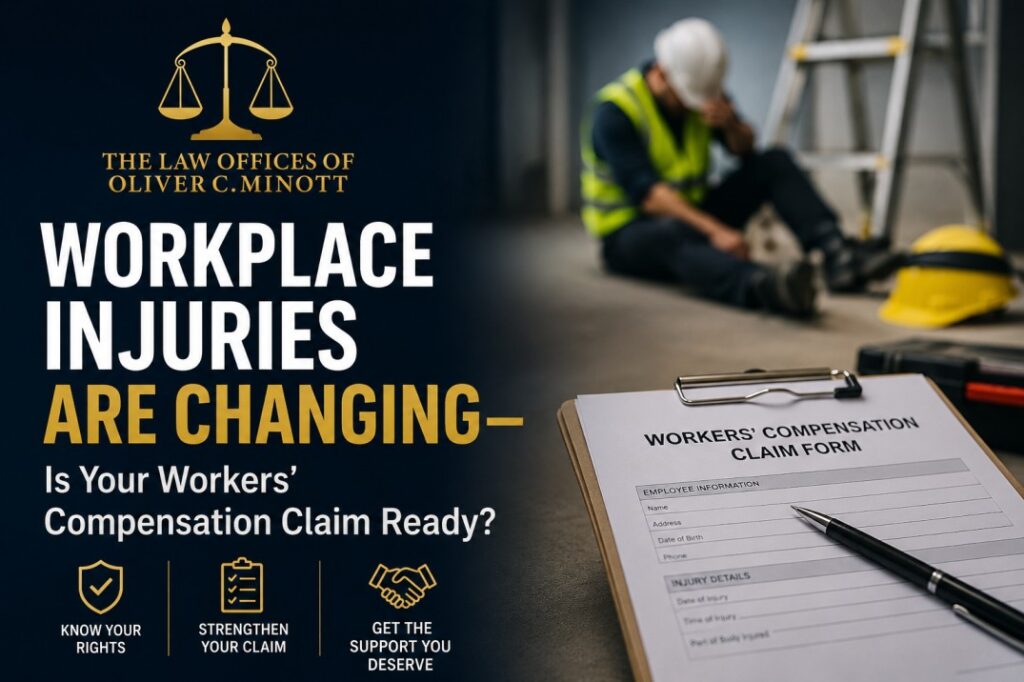
The modern American workplace looks nothing like it did twenty years ago. Remote work, artificial intelligence, gig economy platforms, advanced robotics on factory floors, and shifting labor demographics have fundamentally altered how, where, and why workers get hurt. Yet many injured employees—and even some employers—are still operating under an outdated understanding of what a workers’ compensation claim looks like, what it covers, and what legal protections exist. The result: thousands of legitimate claims are underfiled, undervalued, or outright denied every year.
As workers’ compensation attorneys with decades of combined experience, we have watched these shifts in real time. If you or someone you love has been hurt on the job—whether through a catastrophic construction accident, a repetitive stress injury from years at a keyboard, or an illness caused by toxic workplace exposure—understanding the evolving landscape is no longer optional. It is essential.
The Shifting Anatomy of Workplace Injuries: What the Data Tells Us
According to the U.S. Bureau of Labor Statistics (BLS), approximately 2.6 million nonfatal workplace injuries and illnesses were reported by private industry employers in 2023. While that number reflects a gradual long-term decline in certain categories—largely due to improved safety standards in traditional industries—new and emerging injury types are rising sharply.
Key statistical shifts include:
- Musculoskeletal disorders (MSDs)—including back injuries, carpal tunnel syndrome, and tendinitis—still account for nearly 30% of all days-away-from-work cases.
- Mental health and stress-related claims have risen dramatically since 2020, driven by pandemic-era working conditions and systemic burnout.
- Gig economy injuries (delivery drivers, rideshare workers, freelancers) are now a contested frontier in workers’ comp law, as questions of employment classification remain legally unresolved.
- Heat-related illnesses surged in 2023, with OSHA reporting record-high worker heat exposure incidents tied to climate change.
- Workplace violence claims have increased by over 20% in certain sectors, particularly healthcare, retail, and logistics.
These numbers matter not just as statistics, but as legal realities. The nature of your injury—and when, where, and how it occurred—directly determines the strength and complexity of your workers’ compensation claim.
Common Workplace Injury Categories and Their Legal Implications
The following table outlines major injury types, their typical causes, and key legal considerations:
Injury Type | Common Causes | Key Legal Considerations |
|---|---|---|
Construction Site Injuries | Falls from height, equipment malfunction, scaffold collapse, electrocution | May trigger third-party liability claims alongside workers’ comp; Labor Law §240 (Scaffold Law) in NY |
Slip & Fall / Premises Liability | Wet floors, uneven surfaces, poor lighting, icy walkways | Compensability depends on whether injury occurred within course and scope of employment |
Back & Neck Injuries | Heavy lifting, poor ergonomics, sudden trauma, slip-and-fall | Often contested by carriers; IME (Independent Medical Examination) disputes common |
Repetitive Stress Injuries (RSIs) | Typing, assembly-line work, repetitive overhead tasks | Causation is disputed; requires strong medical documentation linking injury to job duties |
Toxic Substance Exposure | Asbestos, lead, chemical solvents, mold, industrial fumes | Long latency periods; statute of limitations issues; potential for occupational disease claims |
Workplace Violence | Physical assault by coworker, client, or third party | Coverage varies by state; aggressor’s identity and employer negligence both factor in |
Hearing & Vision Loss | Prolonged noise exposure, eye injuries from debris or chemicals | Requires audiological/ophthalmological documentation; often underreported |
Mental Health / PTSD | Trauma from workplace accident or violence, chronic stress | Highly contested; NY law increasingly recognizes standalone mental injury claims |
The Legal Framework: What "Workers' Compensation" Actually Means
Workers’ compensation is a no-fault insurance system established under state law. In New York, it is governed primarily by the New York Workers’ Compensation Law (WCL), which mandates that virtually all employers carry workers’ compensation coverage for their employees. This means that an injured worker generally does not need to prove employer negligence in order to receive benefits—the mere fact that the injury occurred arising out of and in the course of employment (AOE/COE) is sufficient to establish compensability.
However, “no-fault” does not mean “automatic.” Insurance carriers have a legal and financial incentive to minimize payouts. Common strategies employed by carriers to deny or reduce claims include:
- Disputing that the injury was work-related (challenging the AOE/COE nexus)
- Ordering an Independent Medical Examination (IME) with a physician who frequently renders opinions favorable to the carrier
- Arguing that a pre-existing condition—not the workplace incident—is the primary cause of the disability
- Denying claims filed after an employee separation or layoff, alleging the claim is retaliatory or fabricated
- Contesting the claimant’s average weekly wage (AWW), which forms the basis for calculating indemnity benefits
Understanding these tactics is critical. An experienced workers’ compensation attorney can anticipate and counter each of them with proper documentation, medical evidence, and hearing representation.
Emerging Legal Issues in 2025–2026: What's Changed
The workers’ compensation legal landscape has shifted considerably in recent years. Here are some of the most important developments affecting New York claimants:
- Gig Worker Classification
New York has been at the forefront of battles over whether gig economy workers—Uber drivers, DoorDash couriers, TaskRabbit contractors—are “employees” entitled to workers’ comp coverage, or “independent contractors” who are not. The New York Court of Appeals and the Workers’ Compensation Board have issued several rulings clarifying that the economic realities of the working relationship, not mere contractual labels, determine classification. If you were injured while working for a platform-based employer and were told you are not covered, you may still have a valid claim.
- Remote Work Injuries
One of the most contested new frontiers in workers’ comp law involves employees injured while working from home. Courts across the country—including in New York—have grappled with whether a slip-and-fall in a home office, a back injury from an inadequate desk setup, or an ergonomic injury from a kitchen-table workstation qualifies as a work-related injury. The answer, in many cases, is yes—but only if the injury occurred during actual work activity and not during a personal deviation. Meticulous documentation of work-from-home conditions and schedules is now more important than ever.
- Mental Health Claims and PTSD
New York Workers’ Compensation Law has historically required that mental injuries be connected to a physical injury to be compensable. However, this is changing. Following legislative advocacy and court decisions, standalone psychiatric injury claims—particularly PTSD claims arising from witnessed traumatic events or workplace violence—are increasingly being recognized. The DSM-5 diagnosis from a treating psychiatrist or psychologist remains essential in these cases.
- Toxic Substance and Occupational Disease Claims
Occupational disease claims—those arising from prolonged exposure to harmful substances or conditions rather than a single incident—present unique challenges. Under WCL §2(15), an occupational disease must be “distinctive” to the particular employment and not an ordinary disease of life. These claims often involve long latency periods (e.g., mesothelioma from asbestos exposure may not manifest for 20–40 years) and require expert medical testimony linking the disease to workplace exposure. Statutes of limitations in these cases are governed by special discovery rules that can be complex to navigate without legal counsel.
What Benefits Are Available Under New York Workers' Compensation Law?
Many injured workers are unaware of the full scope of benefits available to them. Under New York law, a successful claimant may be entitled to:
- Medical benefits: All necessary and reasonable medical treatment related to the work injury, paid directly by the carrier with no cost to the claimant
- Temporary disability benefits: Wage replacement at 2/3 of the claimant’s average weekly wage (AWW), subject to statutory maximums (currently $1,145.43/week for 2024 injuries)
- Permanent partial disability (PPD) benefits: Compensation for lasting impairment that does not prevent all work activity
- Permanent total disability (PTD) benefits: Lifetime wage replacement for workers unable to engage in any gainful employment
- Schedule loss of use (SLU) awards: Lump-sum payments for permanent loss of use of an extremity, hand, foot, vision, or hearing, based on a statutory schedule
- Death benefits: Payable to surviving spouse and dependents in fatal workplace accidents
- Supplemental benefits: Available under the Aggregate Trust Fund for certain long-term disability cases
It is worth noting that workers’ compensation benefits are entirely tax-free under both federal and New York State law—a significant financial advantage over standard wages.
Critical Steps to Protect Your Workers' Compensation Claim
Whether your injury just occurred or you are already in the middle of a claim, there are specific legal steps you should take immediately to protect your rights:
Step 1: Report the Injury Promptly — Under WCL §18, an injured worker must notify their employer of the injury within 30 days. Failure to do so can result in disqualification from benefits. Verbal notice is legally acceptable, but written notice is strongly preferred.
Step 2: Seek Medical Treatment — You have the right to choose your own treating physician. Only treat with an authorized workers’ compensation provider (listed in the carrier’s medical provider network, where applicable). Your treating physician’s reports will be the backbone of your claim.
Step 3: File a C-3 Form — The Employee Claim form (C-3) must be filed with the Workers’ Compensation Board within 2 years of the accident date (or 2 years from the date you knew or should have known the disease was work-related, for occupational disease claims).
Step 4: Document Everything — Maintain a written log of symptoms, medical appointments, missed workdays, and communications with your employer and carrier. Photographs of the accident scene, when available, can be decisive.
Step 5: Retain Legal Counsel — Workers’ compensation hearings before the New York Workers’ Compensation Board are quasi-judicial proceedings. Insurers will be represented by experienced defense attorneys. You should be too.
Why Claims Get Denied—And What You Can Do About It
A denial of your workers’ compensation claim is not the end of the road. It is the beginning of a formal legal process. Under New York law, denied claims can be contested through:
- Pre-hearing conferences before a Workers’ Compensation Law Judge (WCLJ)
- Full evidentiary hearings at which medical evidence and testimony are presented
- Appeals to the Workers’ Compensation Board Panel (three-member panel review)
- Further appeal to the Appellate Division, Third Department of the New York Supreme Court
The most common grounds for denial—and how they are successfully rebutted—include:
Reason for Denial | Legal Rebuttal Strategy |
|---|---|
Injury not work-related | Witness testimony, incident reports, surveillance footage, and treating physician opinion establishing AOE/COE nexus |
Pre-existing condition | Medical records distinguishing pre-existing condition from acute work injury or aggravation; medical-legal expert testimony |
IME opinion unfavorable | Deposing the IME physician, challenging methodology, contrasting with treating physician opinion |
Missed filing deadlines | Asserting tolling doctrines (e.g., claimant was unaware injury was work-related); arguing equitable estoppel where employer delayed notice |
Employment status disputed | Documentary evidence of work relationship; payroll records; schedule data from platform apps |
Injured at Work in New York? The Law Offices of Oliver C. Minott Is Ready to Fight for You.
Workers’ compensation law is not a matter for self-representation. The stakes—your income, your medical care, your long-term financial security—are too high. At The Law Offices of Oliver C. Minott, we bring over 50 years of combined legal experience to every workers’ compensation and personal injury case we handle across Brooklyn, Queens, Manhattan, the Bronx, Staten Island, Long Island, Upstate New York, and surrounding areas.
Our dedicated team of New York Workers’ Compensation Lawyers and Personal Injury Lawyers will handle every aspect of your case from initial filing through final resolution. We represent injured workers at all Workers’ Compensation Board hearings and appeals—ensuring that you are never navigating the system alone. We have successfully recovered benefits for New Yorkers who suffered:
- Construction site injuries, including scaffold collapses and equipment accidents
- Slip and falls in commercial and industrial settings
- Back, neck, and spinal cord injuries
- Leg, shoulder, elbow, and hand injuries
- Repetitive stress and cumulative trauma disorders
- Vision and hearing impairment claims
- Toxic substance exposure and occupational disease claims
- Personal injury claims arising from workplace negligence
We also handle Social Security Disability (SSD), Supplemental Security Income (SSI), and general personal injury claims. Our firm is licensed to practice in both New York and New Jersey.
At The Law Offices of Oliver C. Minott, we understand that a workplace injury is not just a legal matter—it is a personal crisis that affects every aspect of your life. That is why we treat every client with the compassion, respect, and dignity they deserve, while pursuing their case with complete dedication and tenacity. You will not pay any legal fees unless we win.
Call Now for Your FREE Consultation: (866) 683-4200
Get the answers you need now—on your Workers’ Compensation claim and personal injury claims.
The Law Offices of Oliver C. Minott | New York & New Jersey | (866) 683-4200